
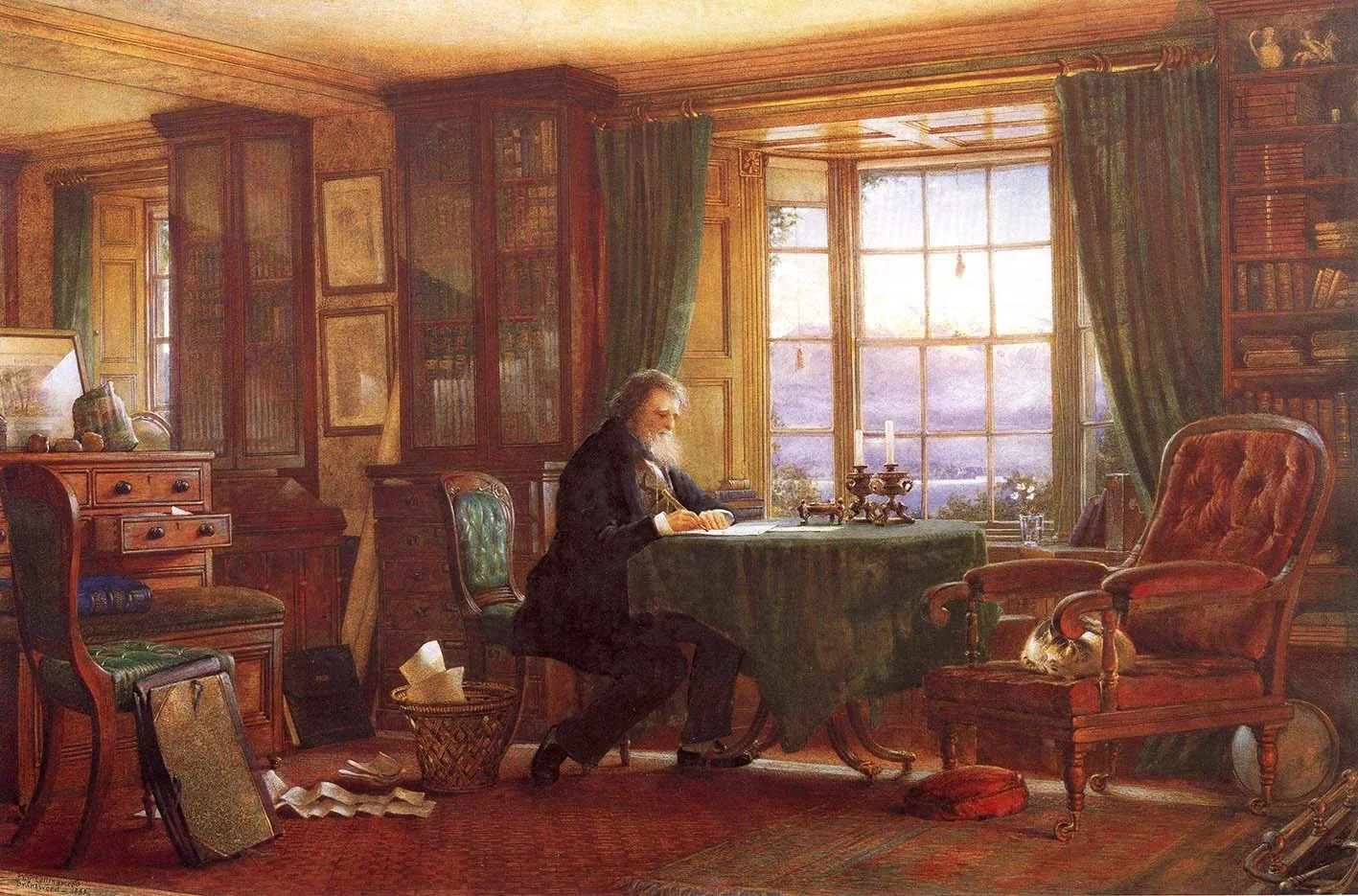
John Ruskin in his study by W G Collingwood
Alongside poetry and prose, landscape painting in the Lake District had been a phenomenon for a couple of hundred years before William Gershom Collingwood organised the Coniston Art Exhibition in 1904. The artist Matthias Reid (1669 – 1747) lived in Whitehaven and was a pioneer of landscape painting in the area. JMW Turner arrived in 1797 as part of his tour of the North of England and would have been seen working at his sketches that Summer, particularly around the Keswick area.
John Constable spent seven weeks doing the very much the same thing in the Autumn of 1806. These artists were doing their bit in London to convince the Royal Academy that Landscape painting was a serious art form but for the most part artists of the time from town and city were reliant upon portraiture to earn a living. There were a number of painters working in the area recording the scenery of the increasingly popular Lake District, among them Alfred Heaton Cooper, whose son William was to become President of the Lake Artists Society in 1960.
The Coniston exhibition however, which was organised by W G Collingwood, a talented painter, archaeologist, antiquarian and friend of John Ruskin was the first time that anyone had considered bringing together a group of mostly professional landscape painters to exhibit their work at a single venue, with a view ultimately to creating a local showcase, where such artists could display their work at an annual event. It was after the success of the Coniston Exhibition that a meeting of the participants took place at the home of Coniston born artist David Gould, a Victorian boarding house called Low Fold, on Lake Road, Ambleside. It was here, on the Wednesday afternoon of October the 12th 1904 that the Lake Artists Society was born.
The 21 founder members although not elected, did fulfil the requirements of being serious, professional painters. Many could not live by sale of their pictures alone and often held jobs in other spheres. They were; W G Collingwood; E M D Collingwood; Edward Arden; Hubert Coutts; Arthur Tucker RDA; Frederick Tucker; David Gould; Fanny Dove Hamel Lister; J H Midgely; Cuthbert Rigby ARWS; Arthur Severn RI; William L Turner; W Smallwood Winder RBA; May Winder; J H Crossland; Joseph Barnes; Gordon Hargrave; Sydney Scott; Beatrice Willink and Frederick Yates*. It can be deduced from this list that the accusation often made that the Lake Artists Society was a Gentleman’s club for leisurely painters, was not true from the outset.
Yes, it was true that the largest number of founder members were male but in the early days of women’s suffrage, the almost 20% female membership probably represented accurately, the number of women painters working in the area at the time. All of the members including W G Collingwood and particularly the Tucker brothers needed to derive an income from their painting, they were working artists.
One of these women, Miss Fanny Dove Hamel Lister was not only a fine artist, she was a force of nature. She had studied at Liverpool school of architecture and art with Augustus John, she and other students set up an independent atelier in Sandon Terrace, Liverpool until the building was demolished. To replace this, Fanny set about first renting and then by tireless fundraising and persuasion, using her social position as Mrs James Calder, finally purchased the buildings known as the Bluecoat Chambers. Her 11th hour fundraising efforts and subsequent restoration projects over 45 years, including repairing severe bomb damage, secured for the city one of its most iconic Art Institutes, The Bluecoat Arts Centre*.
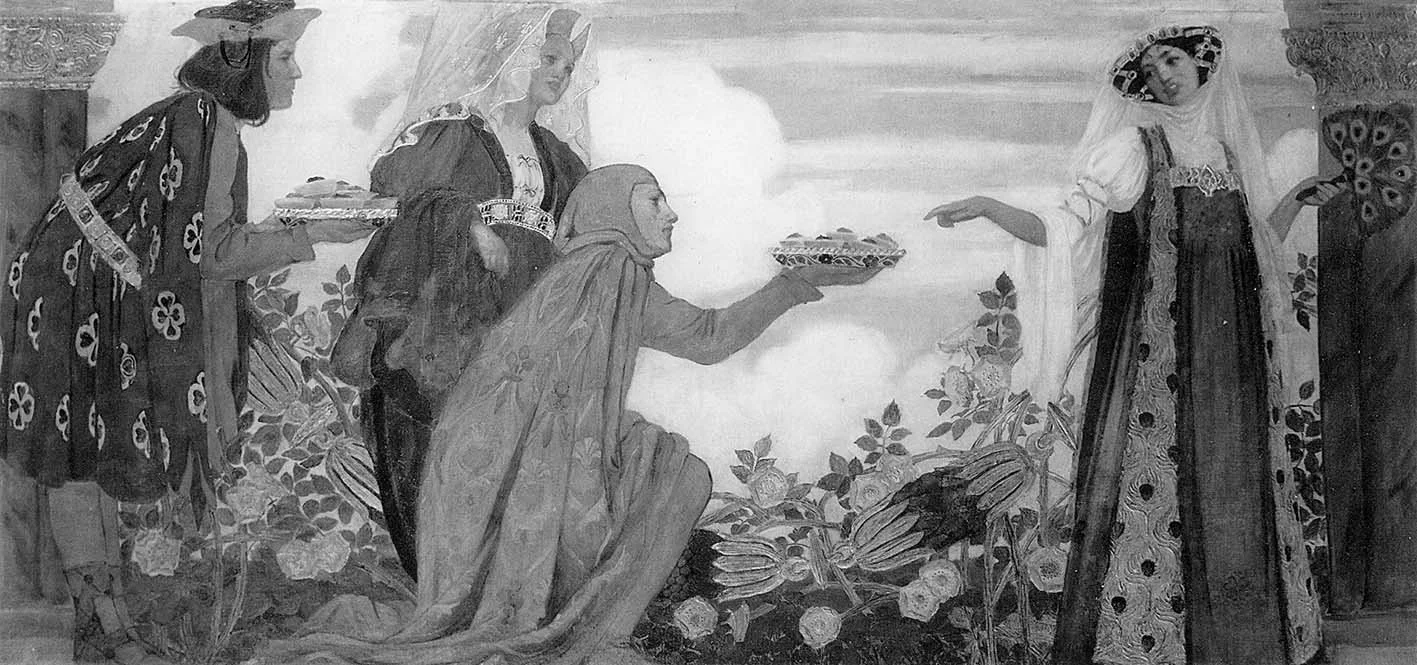
The King and Queen of Hearts by Fanny Dove Hamel Lister
One of the founding rules of the Society was that its members should reside within an area that is now roughly defined by the boundaries of Cumbria. The diversity of the work on show at the Lake Artists Society, then and today is brought about by the individual interpretation of common themes. Unlike many other art societies, throughout its history, the Lake Artists members were never encouraged to be influenced by each other, or to promote jointly a technique or ’ism. It was assumed that its members were competent and professional enough not to seek guidance from visiting artists or lecturers. There was however a move even in the very early years, to invite artists, considered to be of sufficient merit from outside the area, to exhibit with the Lake Artists at their Summer Exhibition.
In 1905 Hubert Coutts (one of the Tucker brothers) was formally elected as President and W G Collingwood as Vice President. A council of three was to be elected each year as a committee, in 1905 that was; Arthur Severn, Arthur Tucker and J H Midgley. Cuthbert Rigby served as Treasurer and Percy Mason as Secretary.
The 1905 exhibition which opened on July 13th was at Coniston, a commission of 15% was levied on sales, a catalogue and posters were ordered from a local printer and a supervisor was engaged to sell admission tickets and catalogues, which in 1905 cost 1d each. Two new members were elected in 1905: Harold Moss of Ulverston and Richard Redfern of Carnforth. Colin Bent Phillip ARWS RWS who lived in North Devon was first invited artist to exhibit in 1905, the son of the painter John ‘Spanish’ Phillip RA, famous for his Spanish dancing and bullfighting scenes, Colin preferred Norwegian and Highland Mountain scenes and was one of the most respected mountain painters of his time. He was elected to the Society after many years as an invitee when he moved to Langdale. In 1932 he succeeded W G Collingwood as President of the Society but died a few weeks later.
1906
The Society was greatly honoured in 1906 to be invited by Canon H D Rawnsley to be the first artists to exhibit at the new Fitz Park Museum and Gallery in Keswick. Over the years the Society was to exhibit at the gallery on eleven occasions, the last time being in 1937.
There were some impressive art works on display at Keswick that year. Fred Tucker, recently elected to the Council, (previously referred to as the committee) showed a painting that had been shown at the RA entitled, ‘Borderland, Cumberland’ overlooking the Solway from Snittlegarth. Another impressive piece was by an invited artist Henry Holiday, whose name and reputation would have caused some interest, he showed a painting entitled, ‘Aspasia Contemplating the Finished Work of Pericles on the Acropolis’ it had a price tag of £350 (over £50,000 in todays money) making it probably one of the most expensive pictures shown at a local gallery at the time. Holiday, a Pre- Raphaelite painter who had studied with Dante Gabriel Rossetti was also a stained-glass designer, succeeding Edward Burne-Jones at Powell and Sons. His famous painting, ‘Dante and Beatrice’ is in the Walker Art Gallery, Liverpool.
Two new members were elected that year, Thomas Cowper ‘Essex’ who combined painting with a career as a soldier, he served in the South African War 1901-2 and as a Lieutenant Colonel in the First World War, He won trophies as a racing driver at Brooklands. He was accidentally killed by a passing car as he stepped out of his car to visit a British War Cemetery in France just before the 1927 exhibition.
Edward George Hobley was at the pinnacle of his very successful career when he was elected to the Society. He was determined to become a painter, despite his parents wanting a secure career for him. Whilst he was apprenticed to Watson’s Drapers in Bradford in 1880, he attended evening classes at Bradford School of Art and won his first silver medal at the age of 19. He was awarded several scholarships that allowed him to study in South Kensington where he gained an Art Teachers Certificate, then an Art Masters Certificate at the Royal College of Art. At 24 he went to the Academie Julien in Paris, the following year he studied at the Atelier of Bougereau and Farrier and l’Ecole des Beaux Arts. He was a great admirer, as were many landscape painters at the time of Henry Herbert La Thangue, more impressed with nature itself rather than the art school methodology, thus furthering the changes to landscape painting that Constable and Turner had begun.
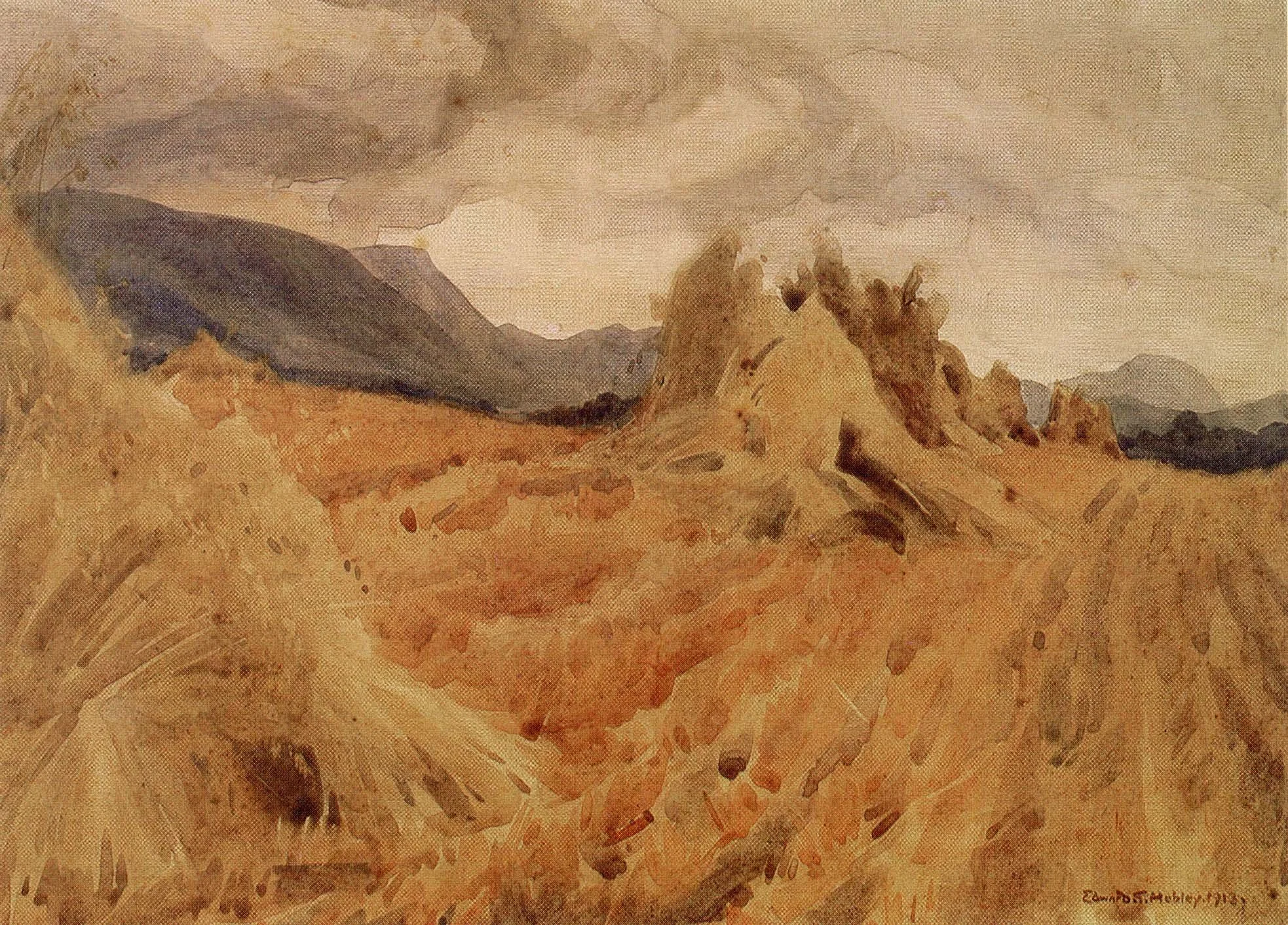
Edward G Hobley ARCA Stooks of Corn and the Ullswater Fells
The late 1800’s and early 1900’s were the years in which, largely in France, the Post Impressionist painters came to the fore, reacting to the natural colours and effects of light that had so steered the Impressionists, by creating works with more structure, symbolism, bolder colour and brushwork. Artists such as Vincent Van Gogh, Paul Cezanne and Paul Gauguin are names most readily associated with this movement. In the rest of Europe however, another movement was underway that to some extent was overshadowed by the Post Impressionists, that was Naturalism. Henry Herbert La Thangue, Jules Bastien-Lepage and Anders Zorn, amongst many others, typified this approach. Combining the lessons learned from formal art training and from Impressionism they set out to portray the lives of ordinary people, with all its hardships and hazards. In the UK, the Newlyn School and the Glasgow Boys produced some of the finest examples and as we shall see, this work found its way into Grasmere Hall and the Lake Artists Society, at their next exhibition.
Acknowledgements; Many thanks to Jane Renouf for her permission to allow use of excerpts from her book
The Lake Artists Society A Centenary Celebration, by Jane Renouf
